Everything you need to know about driving visitors to your website, understanding traffic sources, and measuring success.
What is Website Traffic?
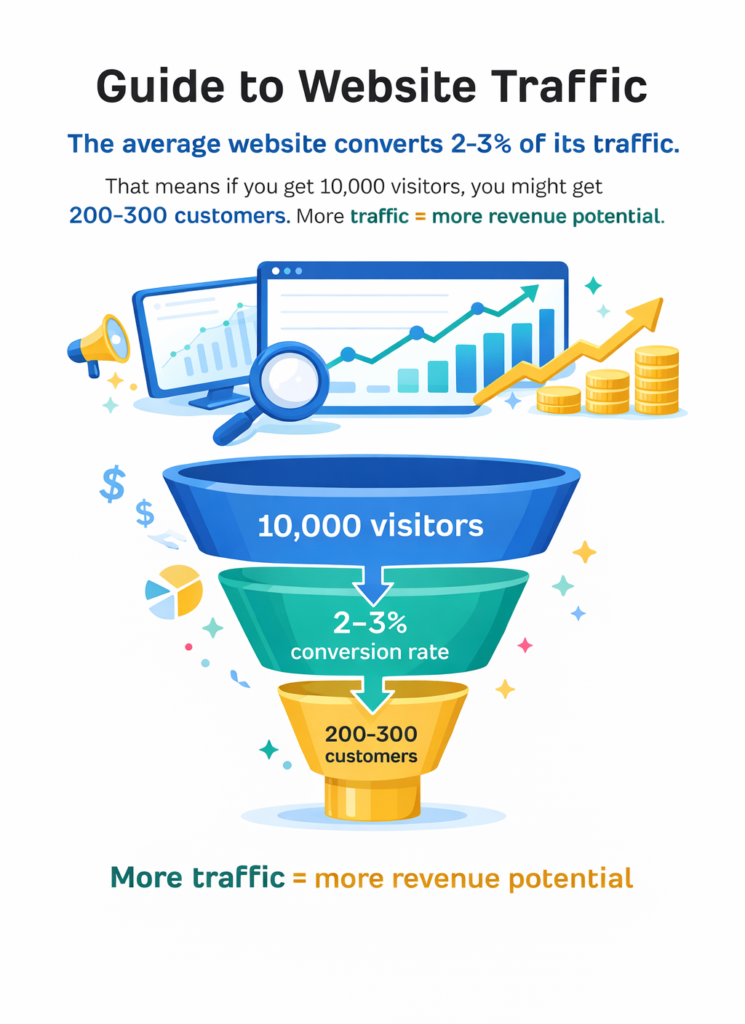
Website traffic is just people visiting your site. Each time someone loads a page, that counts as a visit or session. It’s like foot traffic in a physical store—more people through the door means more chances to make a sale.
Why understanding traffic matters:
- More visitors means more potential customers
- Traffic data shows what’s working and what isn’t
- Different sources convert differently
- Quality beats quantity
Key terms:
- Visitor: A unique person who visits your site
- Session: A single visit, which can include multiple pages
- Pageview: One page loading
- Bounce rate: The percentage who leave after one page
Learn how to check your website traffic using analytics tools
Why Website Traffic Matters for Your Business
Without visitors, even the best website sits empty. Here’s why traffic matters:
Revenue Growth More visitors means more chances to make sales. Simple math: an e-commerce store with 1,000 daily visitors and a 2% conversion rate makes 20 sales per day. Bump that to 5,000 visitors and you’re at 100 sales—5x the revenue with the same conversion rate.
Brand Awareness People who don’t buy today might buy next month. Or tell a friend. Even window shoppers have value.
SEO Authority Google notices engagement. More traffic + good engagement signals = higher rankings, which brings more traffic. It’s a feedback loop when it works.
Data & Insights Traffic tells you what content people like, where they’re coming from, what devices they use, and what actually converts.
Market Validation If people show up, there’s demand for what you’re offering. Traffic is proof someone cares.
| Traffic | Visitors / month | Customers @ 2% | Revenue* |
|---|---|---|---|
Low |
1,000 | 20 | $1,000 |
Medium |
10,000 | 200 | $10,000 |
High |
100,000 | 2,000 | $100,000 |
* Revenue shown is an example. Replace with your average order value (AOV) or profit per customer.
*Based on $50 average order value
Types of Website Traffic Explained
Not all traffic is equal. Here’s what you’re actually getting:
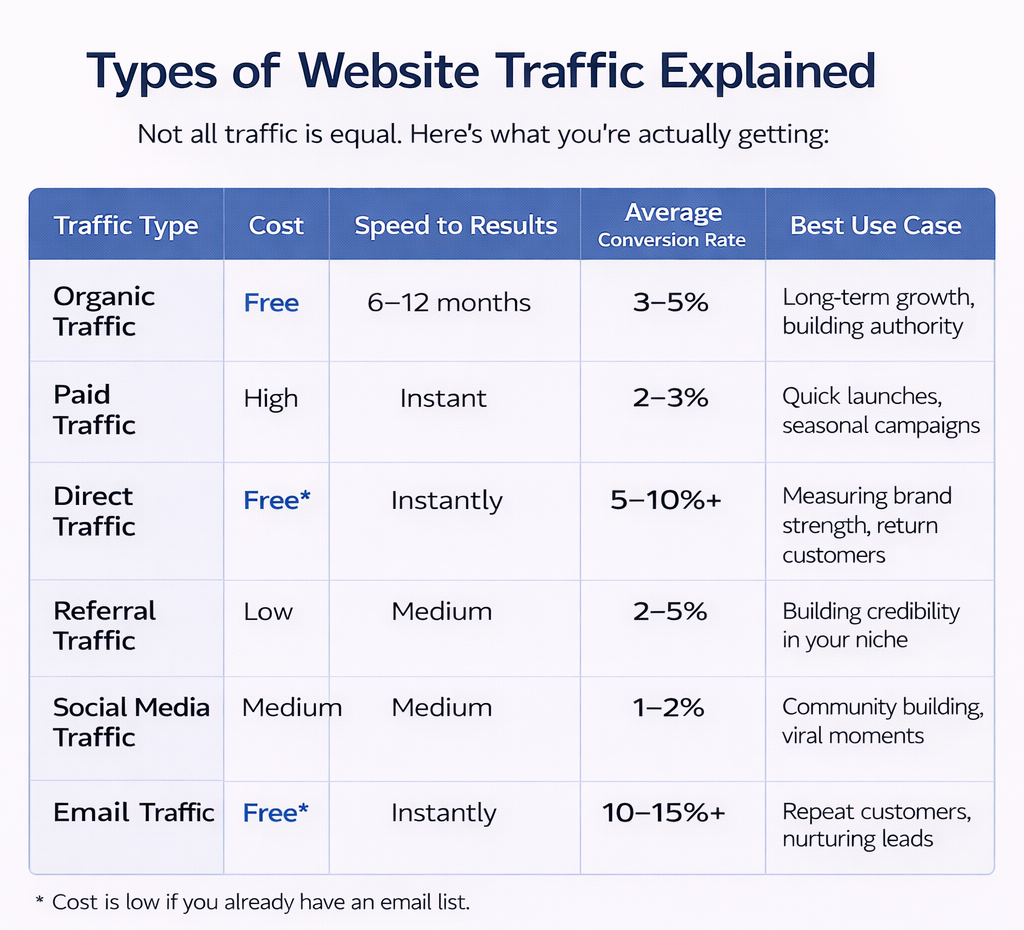
Organic Traffic These are people clicking unpaid search results on Google, Bing, or DuckDuckGo.
What to know:
- Free, but SEO takes work
- High intent—they searched for something specific
- Takes 6-12 months to build
- Converts around 3-5%
Works for: Long-term growth, building authority
Paid Traffic Visitors from ads on Google, Facebook, display networks, etc.
What to know:
- You get results immediately
- You pay per click or impression
- Easy to target specific audiences
- Scales with your budget
Works for: Quick launches, testing new offers, seasonal campaigns
Direct Traffic People who type your URL directly or use a bookmark.
What to know:
- They already know your brand
- Highest trust and intent
- Shows brand recognition strength
- Converts at 5-10% or higher
Works for: Measuring brand strength, return customers
[Internal link DRAFT] How to increase direct traffic to your site →
Referral Traffic Clicks from links on other websites.
What to know:
- Comes from backlinks, guest posts, mentions
- Quality depends on the referring site
- Builds your credibility
- Can be highly targeted
Works for: Building credibility in your niche
Social Media Traffic Visitors from Facebook, Instagram, TikTok, LinkedIn, X.
What to know:
- Great for awareness
- Lower conversion rates (1-2%)
- Visual content performs best
- Needs consistent posting
Works for: Community building, viral moments
Email Traffic People clicking through from your emails or newsletters.
What to know:
- Highest conversion rates (10-15%+)
- Requires an existing list
- Personalized and targeted
- Builds loyalty
Works for: Repeat customers, nurturing leads
Understanding Traffic Sources in Detail
Traffic sources tell you where your visitors come from. Google Analytics breaks them into channels.
Search Traffic (Organic & Paid)
Organic search is when people find you through unpaid results.
Pros: Free, sustainable, quality visitors
Cons: Takes time to build, needs SEO know-how
Example: Someone searches [buy dog food online] and clicks your listing
Paid search is ads at the top of results (Google Ads).
Pros: Instant visibility, precise targeting
Cons: Costs money, stops when your budget runs out
Example: Your ad shows up for [emergency plumber near me]
Learn the difference: Organic vs Paid traffic
Social Traffic
Visitors from social platforms.
Which platform for what:
- Facebook: Local businesses, older demographics (35-65)
- Instagram: Visual brands—fashion, food, travel (18-44)
- TikTok: Viral content, younger audiences (16-34)
- LinkedIn: B2B, professional services, recruitment
- X (Twitter): News, tech, real-time stuff
Social traffic converts lower but it’s good for brand building and retargeting later.
Referral Traffic
Links from other websites that send people your way.
Common sources:
- Industry blogs and publications
- Partner websites
- Directories like Yelp or Yellow Pages
- Press mentions
- Guest posts
Referral traffic from authoritative sites in your niche converts better than random backlinks.
Display & Banner Ads
Visual ads across websites (Google Display Network, ad exchanges).
What to know:
- Good for awareness, not immediate sales
- Lower conversion rates (0.5-1%)
- Cost-effective for exposure
- Works well with retargeting
When to use: Building brand recognition, remarketing to people who’ve already visited
At Traffic Masters, we send real human visitors to your website using premium ad placements with over 600 targeting options. Unlike SEO, which can take months to show results, or social ads that demand constant content creation, our traffic typically begins within 24–48 hours.
Ready to boost your traffic?
Send real people to your website using more than 600 targeting options. Most campaigns begin within 24–48 hours.
Traffic Quality: It’s Not Just About Numbers
Getting 100,000 visitors sounds great until you realize none of them buy anything. Quality beats quantity.
Key Quality Indicators
Bounce Rate
The percentage of people who leave after one page.
Good: 40-60% (depends on your industry)
Bad: 80%+ means poor targeting or a bad user experience
Time on Site
How long people stick around.
Good: 2-3+ minutes
Bad: Under 30 seconds means they’re not engaged
Pages Per Session
How many pages people view per visit.
Good: 2-4 pages
Bad: 1.0-1.2 means they’re bouncing
Conversion Rate
The percentage who do what you want (buy, sign up, download).
Industry averages:
- E-commerce: 1-3%
- B2B services: 2-5%
- SaaS: 3-7%
- Lead generation: 5-10%
Return Visitor Rate
How many people come back.
Good: 30-50%
What it means: Your content is worth revisiting
Warning Signs of Low-Quality Traffic
- High bounce rate (80%+)
- Very short sessions (under 30 seconds)
- Traffic from unexpected countries (when you’re local)
- Zero conversions over weeks
- Random spikes with no corresponding actions
Possible causes: Bot traffic, irrelevant targeting, clickbait, poor landing pages
Website Traffic Metrics That Actually Matter
Google Analytics tracks hundreds of metrics. Here’s what you need to watch:
Volume Metrics
Sessions: Total visits to your site. One person can rack up multiple sessions.
Users: Unique visitors. Counts each person once, even if they visit five times.
Pageviews: Total pages viewed, including repeat views of the same page.
More pageviews per session = better engagement.
Engagement Metrics
Average Session Duration: How long people spend on your site per visit.
Bounce Rate: Percentage who bail after one page.
Pages per Session: Average pages viewed per visit.
What good looks like:
- 2+ minutes per session
- 40-60% bounce rate
- 2+ pages per session
Conversion Metrics
Conversion Rate: Percentage of visitors who complete your goal (purchase, signup, download).
Goal Completions: Total number of desired actions.
Cost Per Acquisition (for paid traffic): How much you spend to get one customer.
Formula: Total ad spend ÷ conversions = CPA
Traffic Source Metrics
Top Traffic Sources: Which channels bring the most visitors?
Top Landing Pages: Where people enter your site.
Exit Pages: Where they leave.
Best Tools for Monitoring Your Traffic
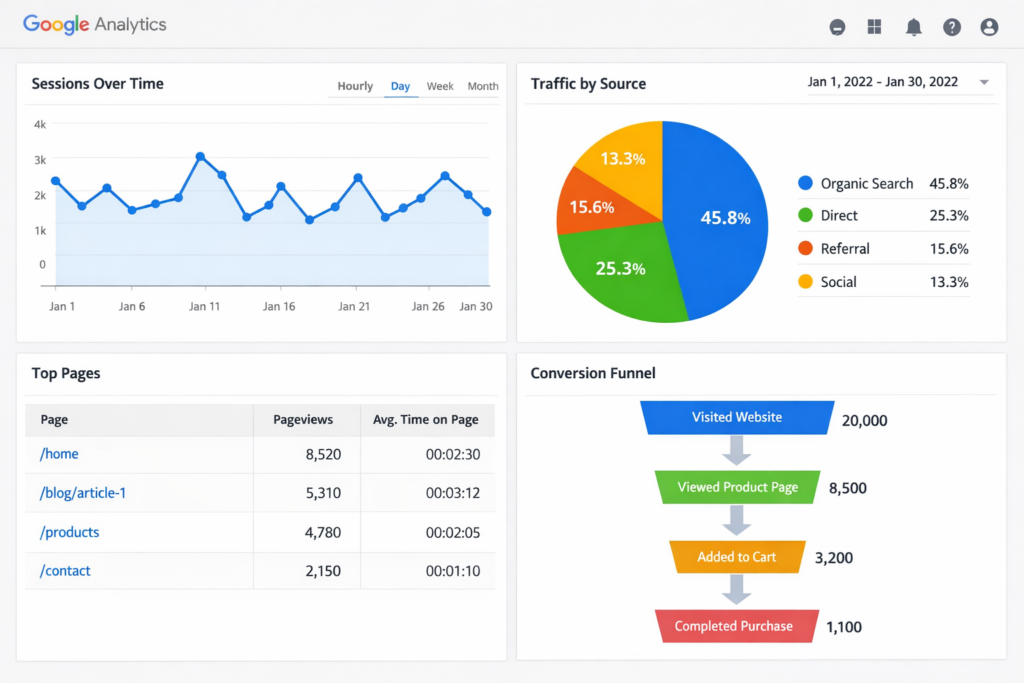
You can’t improve what you don’t measure. Here’s what to use:
Google Analytics 4 (GA4)
Tracks visitor behavior, traffic sources, conversions, and real-time data.
Cost: Free
Best for: Everyone, it’s essential
Google Search Console
Shows search performance, keyword rankings, SEO issues, and which queries bring traffic.
Cost: Free
Best for: SEO tracking
SEMrush / Ahrefs
Competitive traffic analysis, keyword research, backlink tracking, rank monitoring.
Cost: $99-$400/month
Best for: Professional SEO, competitor research
Hotjar / Crazy Egg
Heatmaps showing where users click, session recordings, conversion funnel analysis.
Cost: $39-$99/month
Best for: Understanding user behavior
| Tool | Cost | Best For | Learning Curve |
|---|---|---|---|
| Google Analytics | Free | Essential tracking | Medium |
| Search Console | Free | SEO performance | Easy |
| SEMrush | $99+/mo | Competitive analysis | Hard |
| Hotjar | $39+/mo | User behavior | Easy |
10 Proven Ways to Increase Website Traffic
Now that you understand traffic, here’s how to get more:
1. Optimize for SEO
Target relevant keywords, create quality content, build backlinks, fix technical issues.
Timeline: 6-12 months for real results
2. Buy Targeted Traffic
Get immediate visitors through paid sources. Choose your audience (demographics, interests, location), set your budget, and start receiving visitors within 24-48 hours.
Timeline: Instant
3. Publish Quality Content Regularly
Blog posts (2-4 per month minimum), videos, infographics, guides.
Answer real questions. Use data and examples. Make it shareable. Optimize for keywords.
4. Leverage Social Media
Post consistently (3-5x per week). Use hashtags strategically. Engage with your audience. Run contests or giveaways.
5. Email Marketing
Offer lead magnets (free guides, discounts). Send regular newsletters. Segment your audience. Personalize messages.
Email traffic converts at 10-15% on average.
6. Guest Posting
Write for other blogs in your niche. You’ll get referral traffic, build backlinks for SEO, and establish authority.
7. Paid Advertising
Run campaigns on Google Ads (search and display), Facebook/Instagram, or native advertising networks.
Upside: Immediate and scalable
Downside: Costs add up fast
8. Video Marketing
Create YouTube content—tutorials, product reviews, industry insights.
9. Influencer Partnerships
Collaborate with influencers through sponsored posts, product reviews, or co-created content.
10. Update Old Content
Refresh existing posts with new information, updated statistics, better formatting, and re-promotion.
Google favors fresh, updated content
| Method | Cost | Speed | Difficulty | Sustainability |
|---|---|---|---|---|
| SEO | Low–Medium | Slow | Hard | High |
| Buy Traffic | Medium | Fast | Easy | Medium |
| Content Marketing | Low | Medium | Medium | High |
| Paid Ads | High | Fast | Medium | Low |
| Social Media | Low | Medium | Medium | Medium |
Frequently Asked Questions About Website Traffic
How much traffic do I need to make money?
It depends on your business model and conversion rate. Rough guidelines:
- E-commerce: 10,000+ monthly visitors for sustainable income
- Affiliate sites: 50,000+ monthly visitors
- Local services: 1,000-5,000 monthly visitors
- B2B: 5,000-10,000 monthly visitors
More important than total traffic: targeting the right audience and optimizing conversions.
Is buying website traffic safe?
Yes, when you use legitimate providers. Look for real human visitors (not bots), transparent tracking in Google Analytics, no fake engagement, and money-back guarantees.
How long does it take to see results?
- Paid traffic (buying traffic, ads): 24-48 hours
- SEO: 6-12 months
- Content marketing: 3-6 months
- Social media: 2-6 months
Most businesses combine multiple strategies.
What’s a good conversion rate?
Industry averages:
- E-commerce: 1-3%
- Lead generation: 5-10%
- B2B services: 2-5%
- SaaS free trials: 3-7%
If you’re below these, focus on conversion optimization instead of just traffic.
Can I get free website traffic?
Yes, through SEO, social media (organic posts), content marketing, and email marketing.
Free doesn’t mean easy—these methods take significant time.
What’s the difference between traffic and visitors?
- Visitors/Users: Unique people who visit
- Traffic/Sessions: Total visits (one person can visit multiple times)
- Pageviews: Total page loads
Example: One visitor might have 3 sessions and 15 pageviews in a month.
Ready to Grow Your Website Traffic?
You now know what website traffic is, the different types and sources, how to measure quality, and strategies to increase visitors.