
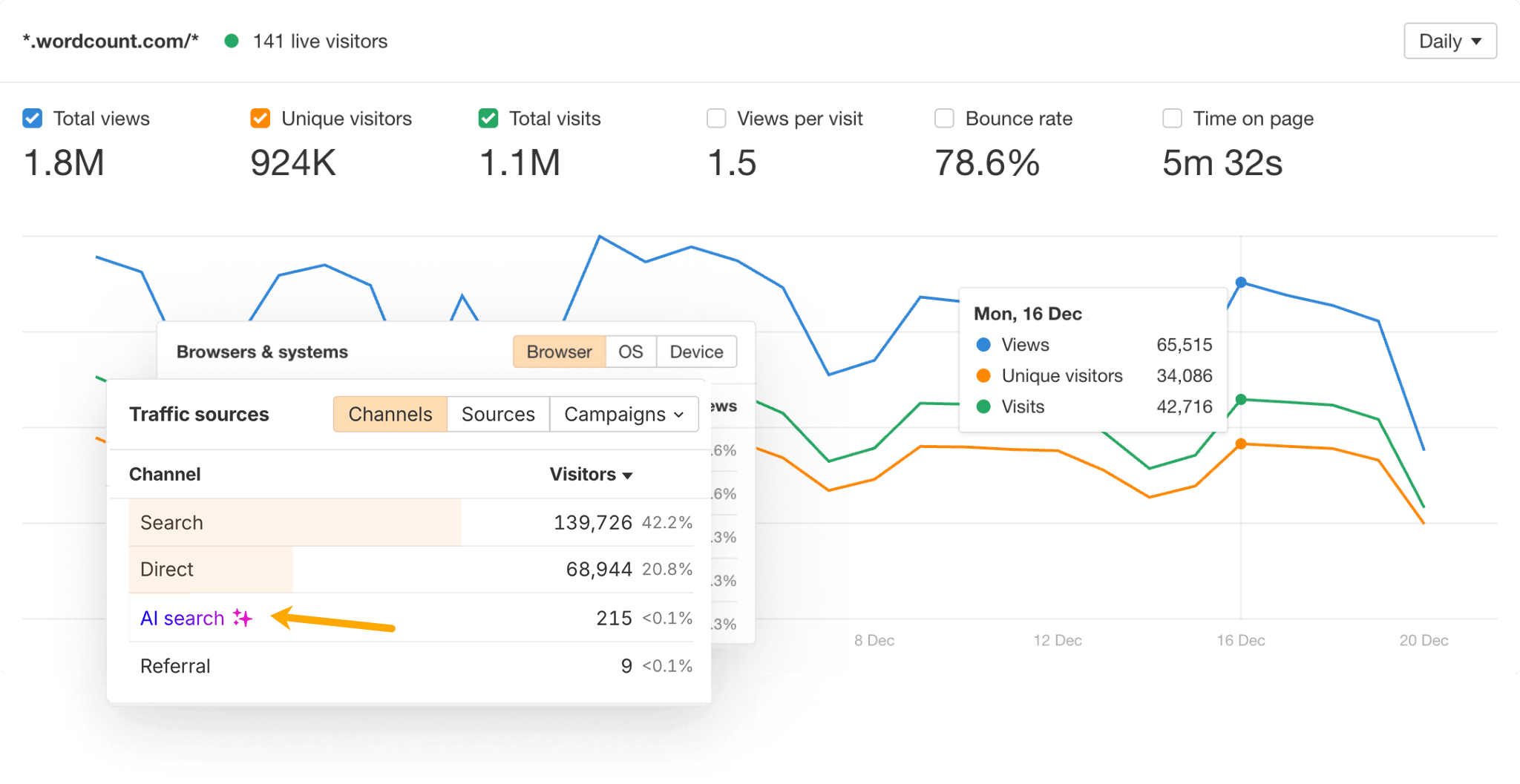
AI referral traffic is visits to your website that originate from AI platforms like ChatGPT, Claude, Perplexity, and Gemini — when those platforms include a link to your content and a user clicks it. The problem is that GA4 does not track this traffic accurately by default, lumping most of it into “Direct” or generic “Referral” buckets where it becomes invisible. Setting up a custom channel group with the right regex patterns fixes this in about 15 minutes.
What Exactly Is AI Referral Traffic?
When an AI assistant like ChatGPT recommends your website and a user clicks the link, that visit is AI referral traffic. It is fundamentally different from organic search traffic — the user did not type a query into Google, they asked an AI and followed its suggestion.
AI-driven sessions grew 527% year-over-year in early 2025. That number is not a rounding error — it reflects a genuine shift in how people discover and navigate to websites. If you are not tracking it, you are missing one of the fastest-growing acquisition channels on the internet.
This matters whether your AI traffic arrives organically (because an AI cited your content) or deliberately (because you have taken steps to appear in AI-generated answers). Either way, you cannot optimise what you cannot see.
Why Does GA4 Miss AI Referral Traffic by Default?
GA4 was built around traditional referral patterns — search engines pass a referrer string, campaigns use UTM tags. AI platforms do not always follow these conventions, and the result is misattribution at every level.
Here is how AI traffic gets lost in GA4:
- Copy-paste behaviour: Many users copy a URL from a ChatGPT response and paste it into a new tab. No referrer is passed. GA4 records this as Direct traffic.
- Incomplete UTM tags: ChatGPT sometimes appends
utm_source=chatgpt.combut omitsutm_medium. GA4 places these sessions in the “Unassigned” channel. - Generic referral bucket: When users do click a link directly from Claude or Perplexity, GA4 lumps it into “Referral” alongside blog links and random backlinks — indistinguishable from everything else.
The net effect: a significant portion of your AI referral traffic is hidden in plain sight, recorded under channels that tell you nothing useful.
Which AI Platforms Send Trackable Referral Traffic?
Not all AI traffic is equally trackable. Here is what GA4 can and cannot capture:
- ChatGPT (chatgpt.com) — Trackable when users click links directly. Some sessions also tagged with
utm_source=chatgpt.com. - Claude (claude.ai) — Trackable as a referral domain when users click through from conversations.
- Perplexity (perplexity.ai) — Trackable. Perplexity is link-heavy in its responses, making it one of the more reliably attributed AI traffic sources.
- Gemini (gemini.google.com) — Trackable as a referral from the Gemini web app.
- Google AI Overviews — Not separately trackable. This traffic arrives tagged as
google / organicand cannot be isolated from regular search traffic in GA4. - Microsoft Copilot — Partially trackable via
bing.com/chatreferrers.
The big four to focus on are ChatGPT, Claude, Perplexity, and Gemini. Together they account for the vast majority of AI referral traffic that is actually attributable.
How Do You Set Up AI Referral Tracking in GA4?
The most reliable method is creating a Custom Channel Group in GA4. This lets you define an “AI Referral” channel that captures all the relevant traffic sources in one reportable bucket.
Here is the step-by-step process:
- Go to Admin → Data Display → Channel Groups in your GA4 property.
- Click “Create New Channel Group” and name it something clear like “AI Traffic Tracking”.
- Add a new channel and name it “AI Referral”.
- Set the condition type to Session source and select matches regex.
- Enter the regex pattern (see below).
- Save and allow 24–48 hours for data to populate.
The custom channel group applies retroactively to your historical GA4 data, so you will immediately see AI referral traffic going back to when your property started collecting data.
What Regex Pattern Should You Use for AI Sources?
This single regex captures the major AI referral sources across both the session source dimension and UTM-tagged sessions:
chatgpt\.com|claude\.ai|perplexity\.ai|gemini\.google\.com|bing\.com/chat|you\.com|phind\.com|copilot\.microsoft\.comApply this pattern to the Session source condition in your channel definition. For complete coverage, also add a second condition using an OR rule targeting sessions where utm_source matches:
chatgpt\.com|openai|anthropic|perplexity|geminiWhy both conditions? Because GA4 attributes traffic based on whichever signal is present. Some visits have a referrer domain; others carry UTM parameters. Covering both ensures you catch the full picture rather than half of it.
How Do You Validate the Setup Is Working?
Once you have created your custom channel group, use the Explorations section in GA4 to verify it is capturing data correctly.
Build a free-form exploration with these settings:
- Dimension: Session source/medium
- Metric: Sessions
- Filter: Session source contains “chatgpt” OR “claude” OR “perplexity”
If you see sessions appearing under those sources, your setup is working. If the numbers look lower than expected, that is normal — copy-paste behaviour means a portion of your AI referral traffic will always land in Direct and cannot be recovered.
For a quick sanity check without setting anything up, you can also go to Reports → Acquisition → Traffic Acquisition and filter the “Session source/medium” dimension to search for “chatgpt” or “perplexity” directly.
What Do You Do With AI Referral Traffic Data Once You Have It?
Tracking AI referral traffic is only useful if you act on what you find. Here is how to use the data:
Identify which pages AI platforms cite most. Look at landing pages for your AI Referral channel. These are the pages AI engines trust enough to recommend. They tell you what content format, depth, and structure AI tools prefer — and give you a blueprint for what to publish next.
Measure conversion quality. AI-referred visitors tend to be further along in their research. Compare conversion rates and session duration for AI referral vs. organic search. In most cases, AI referral sessions last longer and convert better — because the AI has already pre-qualified the visitor’s intent.
Compare AI platforms against each other. Perplexity traffic may behave differently from ChatGPT traffic. Breaking it down by source tells you where to focus your answer engine optimisation efforts.
If you want to accelerate results while your organic AI presence grows, you can also buy web traffic from AI platforms directly — Traffic Masters offers targeted visitor traffic from ChatGPT, Claude, and Gemini referrers, letting you validate your pages and build engagement signals while earning organic AI citations takes time.
How Is AI Referral Traffic Different From Organic Search?
The difference matters more than most marketers realise. Organic search traffic arrives because your page ranked in Google’s index. AI referral traffic arrives because an AI system decided your content was credible and relevant enough to recommend in a conversation.
AI systems do not rank pages — they cite sources. The criteria for citation are different from traditional ranking signals. E-E-A-T signals, structured content, direct answers, and factual depth carry more weight in AI citation decisions than they do in traditional SEO rankings.
This is why tracking AI referral traffic separately is so important: it is a distinct acquisition channel with its own logic, its own optimisation levers, and its own conversion behaviour. Lumping it into “Direct” or “Referral” makes it impossible to understand or improve.
Should You Bother Tracking AI Traffic If Your Volume Is Low?
Yes — and this is particularly true right now. AI referral traffic is still in its early growth phase, which means the sites that establish tracking and measurement infrastructure today will be positioned to act on the data as volume scales.
The keyword “ai referral traffic” has low search volume today, but so did “mobile traffic” in 2011 and “social referral traffic” in 2009. Both became major channels within 18–24 months. The trajectory here is similar.
Traffic Masters is one of the only providers already delivering AI referral traffic at scale — learn more about their AI traffic service if you want to test your pages with real AI-sourced visitors before organic volume matures.
Setting up the custom channel group in GA4 takes 15 minutes. The cost of not having that data — especially as AI-referred sessions continue to grow — is measured in missed optimisation opportunities and invisible ROI.
Quick Summary: AI Referral Traffic Tracking Checklist
- ✅ Create a Custom Channel Group in GA4 (Admin → Data Display → Channel Groups)
- ✅ Add an “AI Referral” channel using the regex pattern above
- ✅ Target both Session source and utm_source dimensions
- ✅ Validate using Explorations with a source/medium filter
- ✅ Monitor landing pages for AI-cited content
- ✅ Compare conversion rates: AI referral vs. organic search
- ✅ Review monthly as AI platform referral patterns evolve
AI referral traffic is real, it is growing fast, and it converts well. The only question is whether your analytics setup is ready to capture it — and now it will be.